
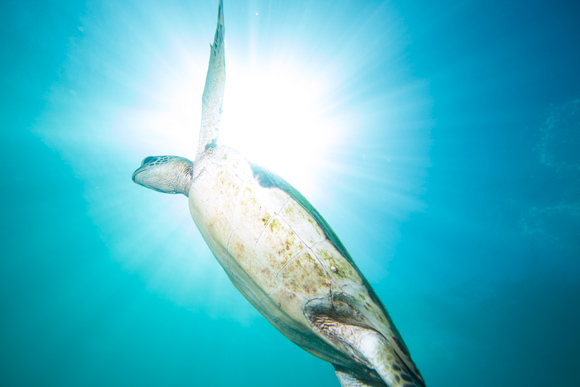
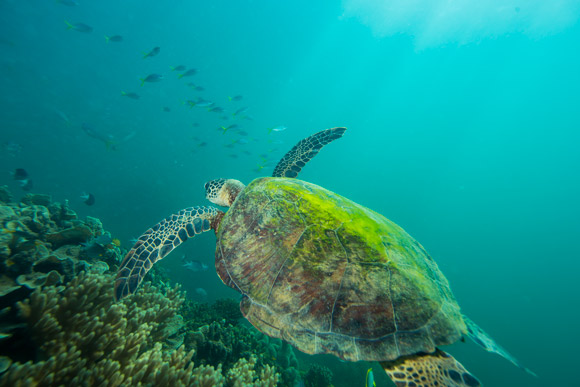
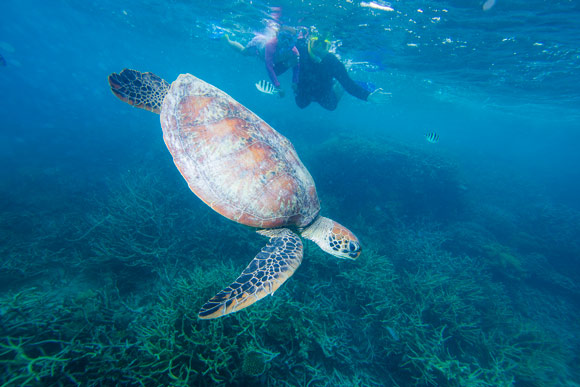
He lifts his head from the coral reef and turns to make eye contact with me. He holds it for a few seconds before returning to pluck at the plants growing between coral heads and tables. I move in closer and he pushes off. With a few slow, lazy flipper swoops, he glides across the reef. Tropical fish, in an impossible spectrum of colours, flit out of his way. I can't help but swim alongside this unusual creature. Nearly a metre long this algae-fringed green sea turtle hardly seems bothered by my presence. I have to swim slowly to maintain eye-contact with him.
This is just one of those experiences that makes the Great Barrier Reef such a beautiful place to visit. But, despite their laidback demeanour, the turtles are in trouble.
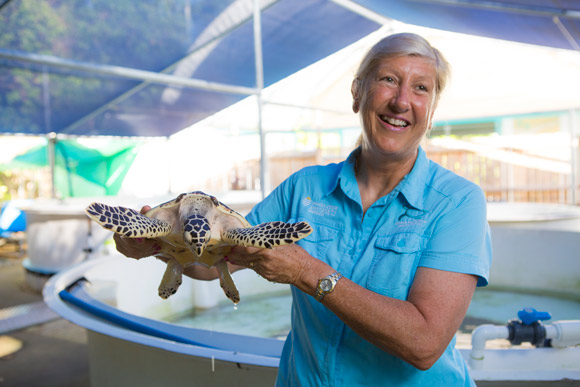
Jennie Gilbert is a charismatic veterinary nurse and technician with a pathology diploma, zoology and marine biology training. She is currently studying for her PHD. Jennie chuckles at the suggestion she may be a professional student. She runs Cairns Turtle Rehabilitation Centre out of a base in Cairns and one on Fitzroy Island on the southern edge of Great Barrier Reef. Formed in 2000, the centre has become increasingly more important in the health of turtles on the reef.
"We had cyclone Larry, then floods, then the wet dry season and then cyclone Yasi," explains Jennie. "The inshore seagrass beds were wiped out around the East Coast of Queensland. That culminated in an 800% increase in turtle strandings – we couldn't cope and so the owner of the resort on Fitzroy Island donated some land to help us create another centre – what we consider to be our fattening farm."
The rehab centres are powered by an army of 58 volunteers. It takes between 6 months and 3 years for a turtle to reach full recovery.
Once the turtles have reached a clean bill of health the juveniles are released into the clear waters off Fitzroy Island and the adults are returned to where they were found to help reconnect them to their breeding grounds – Qantas offers free flights for the turtles to help facilitate this.
"We get turtles from Cape York that get entangled in discarded fishing nets," Jennie continues. "Those turtles are always returned to Cape York."
The centre deals with a lot of turtles that are suffering from starvation, but they also encounter turtles starving beause of "floaters syndrome" – air under the shell caused by an obstruction in the gut, boat strike or impact to the shell, that prevents them from diving.
"Ghost nets" were responsible for a lot of flipper amputations Jennie said.
"Out in the wild crocodiles and sharks predate on turtles and they ocassionally lose their flippers that way, but they recover and cope extremely well. They are a really adaptable animal."
Green sea turtles are listed as vulnerable, but Jennie believes the northern population is not doing very well. The hawksbill turtles are endangered in Australia, but are critcally endangered worldwide because they are hunted for their shells for use in jewellery and furniture.
To support the ongoing work of Jennie and her team click here.
See you at the beach ...
Derek
PS Want a dream home with incredible ocean views in St Clair? Check this one out. Open home Sunday, May 11, 1:30-2pm.

Proudly supported by: